


One aspect of the Trump administration’s war on science and expertise that has not given nearly the attention that it deserves by the mainstream press is the current carnage at the National Institutes of Health (NIH) under the “leadership” of its current director, Dr. Jayanta Bhattacharya. While the mainstream press is filled with stories—and rightly so!—about what the longtime antivax activist who is now Secretary of Health and Human Services, Robert F. Kennedy Jr., has done thus far to dismantle the Centers for Disease Control and Prevention (CDC) as a reliable federal resource for public health, eliminating as many vaccines as he can from the US schedule as fast as he can (as if he senses that he has less than three years to eliminate all vaccines in the US), and working on turning the Food and Drug Administration (FDA) into yet another arm of his antivax quackery-fueled “make America healthy again” (MAHA) movement, the dismantling of the NIH and, with it, likely the dominance in biomedical research that the US has enjoyed for decades gets a lot less attention. Worse, when it does get attention, there’s an unfortunately good chance that it will be in the form of a fawning interview in the New York Times by a hack pundit like Ross Douthat about “restoring trust” in science, which is—among other things—what prodded me last week to get off my duff and write a post that I’ve been meaning to write for weeks now about how Dr. Bhattacharya is serving as the useful idiot and figurehead under which the NIH is being transformed into the “research arm” of MAHA. If that’s not Lysenkoism 2.0 (as I’ve been calling it), I don’t know what is.
Taken in context, the MAHA takeover of the NIH under the figurehead “direction” of Dr. Bhattacharya is, as I’ve written before, an extinction-level threat to public health and biomedical research in this country. Quite frankly, it could well mean the end of the relatively apolitical—or at least nonpartisan—research agenda of the NIH for a generation, with the NIH being turned into yet another patronage system under a profoundly transactional President.
Before I get to discussing in depth how Dr. Bhattacharya’s puppetmasters are bringing back the ghost of Trofim Lysenko, let’s look at a little backdrop. What has the administration been doing to the NIH over the last year?
Hollowing out federal scientific expertise
Before a discussion of what Dr. Bhattacharya claims and says, it’s useful to compare whatever he says to an actual analysis published in Science a week ago, US government has lost more than 10,000 STEM Ph.D.s since Trump took office:
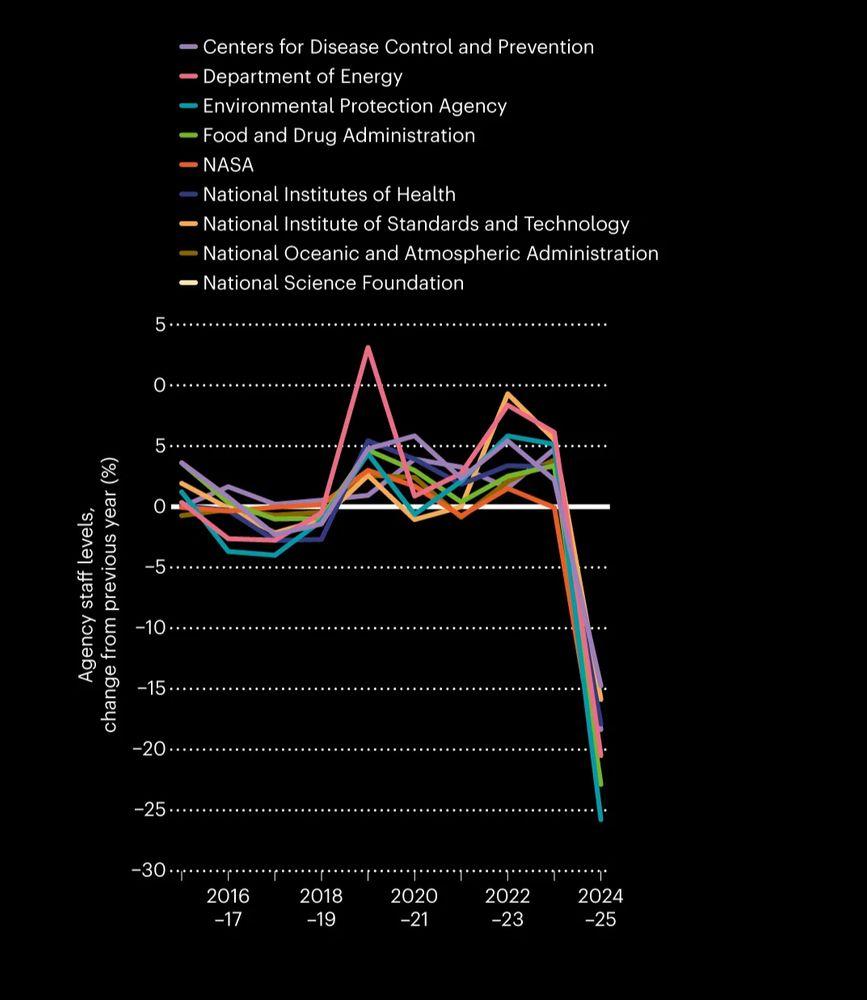
Some 10,109 doctoral-trained experts in science and related fields left their jobs last year as President Donald Trump dramatically shrank the overall federal workforce. That exodus was only 3% of the 335,192 federal workers who exited last year but represents 14% of the total number of Ph.D.s in science, technology, engineering, and math (STEM) or health fields employed at the end of 2024 as then-President Joe Biden prepared to leave office.
The numbers come from employment data posted earlier this month by the White House Office of Personnel Management (OPM). At 14 research agencies Science examined in detail, departures outnumbered new hires last year by a ratio of 11 to one, resulting in a net loss of 4224 STEM Ph.D.s. The graphs that follow show the impact is particularly striking at such scientist-rich agencies as the National Science Foundation (NSF). But across the government, these departing Ph.D.s took with them a wealth of subject matter expertise and knowledge about how the agencies operate.
This is a dramatic brain drain, as well as loss of institutional memory and expertise. As PZ Myers put it, “They aren’t coming back, you know.” He’s right, too:
Perhaps you would like me to reassure you that once we throw the rascals out and elect responsible politicians who respect the role science has played in American prosperity, we’ll just hire them back. No, sorry, this isn’t like rehiring workers at the Amazon warehouse. A science hire is accompanied by a large investment in equipment and personnel.
Correct. Let’s assume a best-case scenario for US federal support of science, one in which a science-loving Democratic candidate elected on a promise to rebuild HHS agencies is elected in 2028. By January 20, 2029, when that candidate will take office, the vast majority of the scientists who have been forced out will have either found other jobs in industry (or, less likely, academia), left the US to find work elsewhere, or been forced to change their careers. The “just hire them back” attitude shows a profound lack of understanding of how scientific programs are built. Here’s a graphical representation of the carnage in terms of overall staffing at key federal scientific agencies, many at HHS:
Worse, as RFK Jr. implants his MAHA agenda into every HHS agency, the scientists hired over the next three years to replace some of the ones forced out will likely all have to bend the knee to the MAHA agenda. Many will be believers or at least sympathetic to MAHA, and they will have reshaped the federal science workforce, and a new President dedicated to restoring past norms won’t be able to just purge them the way that President Trump has purged so many scientists from the federal government.
I want to talk about one more thing before I look in depth at what Bhattacharya claims that he wants to do and balance it against what the Trump administration is actually doing to the NIH, with him as the willing figurehead. As you will see, it’s very much of a piece with what Soviet scientist Trofim Lysenko did to Soviet agriculture for decades: Replace rigorous science with ideology-based “science.” I’ve written about that before a number of times; so if you want more information, I refer you to my posts on the subject, specifically “Make America Healthy Again”: The new Lysenkoism, Lysenkoism 2.0 and the dismantling of the NIH, and Jay Bhattacharya’s “plan to drive Gold Standard Science”: A Trojan horse for Lysenko-izing the NIH.
But first, a bit about what the NIH was and why its coming transformation into a research arm for MAHA matters.
The NIH: Crown jewel of US federal science
I’ve said it before many times, but I’ll start by saying it again here. The NIH, along with the National Science Foundation, represents one of the crown jewels of US federal science. One reason is that it is the largest public funder of biomedical research in the world, with a budget before Donald Trump took over of over $47 billion. However, its sheer size with respect to how much it funds biomedical research is not the whole story. One reason why the NIH has been such a driver of innovation and scientific discovery since a major reorganization in 1948 that created several of the Institutes that make up the NIH is the manner in which it funds biomedical research. While there has long been a large and healthy intramural research effort at the actual NIH campus in Bethesda, MD, complete with clinical trials carried out at the NIH Clinical Center, the largest hospital in the US devoted entirely to clinical research, most of the funding of biomedical research by the NIH consists of research grants to universities, hospitals, research institutes, and private companies through a highly competitive process in which researchers submit grant applications to the NIH.
It turns out that over 80% of NIH funding goes to funding extramural research grants (extramural=not funding labs at the NIH itself). Moreover, there is a long-defined, rigorous, and codified process used by the NIH to evaluate grant applications. It begins with the submission of a grant to the NIH, and the NIH has a number of granting mechanisms designed for different purposes. For example, the R21 grant is designed for preliminary work, often the “higher risk” studies that the brave mavericks demand, and doesn’t require a lot of preliminary data. (The claim that it can require no preliminary data, however, is generally nonsense. You need at least some data.) R21s can fund up to two years and cannot be renewed.
In contrast, the granddaddy of them all, the “gold standard” grant for an individual investigator, small groups of co-investigators, or collaborators, is the R01, which can be funded for up to five years (it’s also one of the only grant mechanisms where the investigator can propose basically anything, rather than having to address a particular topic or question). At the end of that time, the investigator can apply for a competitive renewal, which can extend the grant for up to another five years, and so on ad infinitum. There are a number of other grant mechanisms, which include training grants for graduate students, center grants (e.g., for cancer centers), larger multi-investigator grants, and more targeted grants—Wikipedia has a nice list here—but in general all of them are scored by groups of scientists with the relevant expertise in a review group called a study section, of which there are dozens in the NIH arranged by topic into Review Branches at the Center for Scientific Review. Many of these study sections are permanent, but the NIH can and does set up temporary study sections for topics of special interest at the time. Again, the system is about scientific rigor and funding the best science, at least as much as any human-created and run institution can be.
Is the NIH perfect? Obviously not. I’ve had a number of complaints about the NIH, including how low the paylines have fallen. (Before Trump, paylines had fallen below the 10th percentile, meaning that less than 10% of grant applications were funded, and now they’ve fallen below the 5th percentile.) Similarly, I’ve on occasion discussed how the NIH funding system doesn’t encourage new researchers enough, all too often leading to a “rich get richer” situation. Indeed, my complaints sometimes even echo those of people like Dr. Prasad; it’s just that I view their proposed “solutions” to be, in general, very bad ideas. However, it is and remains (for now) an amazing example of what government can accomplish when motivated by the public good. Moreover, it still maintains broad bipartisan support. When the Trump administration submitted a budget in May that would have cut the NIH budget by 40%, Congress pushed back. Its FY2026 budget appears not just to restore the cuts but to increase the NIH budget by 1%. Of course, that is, in essence, a budget cut accounting for inflation, and the NIH budget has been flat or slowly declining for years, but it’s a hopeful sign. From my perspective, many of the problems—not all, obviously, but many—with the NIH could be solved with more robust and stable funding.
What really makes the NIH stand out, however, is just how assiduously administrations since the Truman administration have insulated it from political considerations and generally not meddled—at least not overmuch—in scientific decisions. Of course, I realize that it is impossible to completely insulate the NIH from politics. After all, each administration chooses an NIH Director, and Congress examines the budget request from each Director and administration and decides on its appropriations, sometimes including legislation tasking NIH Directors to emphasize certain priorities or set up specific programs. Usually, such Congressional mandates have broad bipartisan support, rather than representing an ideological program like MAHA. The Cancer Moonshot initiative championed by Sen. Joe Biden in 2016 is one example of an NIH research program mandated by Congress. Although I thought the Cancer Moonshot overhyped what could be accomplished, it nonetheless had broad support. Sometimes, such meddling is less than benign, for instance when Sen. Tom Harkin championed the National Center for Complementary and Alternative Medicine (NCCAM, now renamed the National Center for Complementary and Integrative Health, or NCCIH), creating and protecting a Center devoted to studying the sort of pseudoscience that MAHA champions. One might even look to NCCIH as a precursor and cautionary tale as to what can happen when political and ideological meddling infects the NIH.
Even if one views NCCIH as a predecessor to the MAHA Research Institute NIH, our complaints published on SBM about NCCIH going back to the very beginnings of this blog about how NCCIH represents ideological pseudoscience that the NIH was forced to accept and fund due to political meddling seem almost quaint compared to what is happening at the NIH now, which is the full-on Lysenkoization of the NIH, even as its funding decisions increasingly become ideology-based rather than science-based.
Podcast Jay lets his COVID freak flag fly
Regular readers will know that SBM (in particular Dr. Jonathan Howard and I) view Dr. Bhattacharya as not only grossly unqualified to lead such a large and prestigious institution as the NIH, and that’s even leaving aside how he got the job. Recall that Dr. Bhattacharya first rose to prominence in October 2020 as one of the three co-authors of the Great Barrington Declaration, a bit of dangerous pseudoepidemiology that proposed a “let ‘er rip” approach to the pandemic to develop “natural herd immunity” within three to six months, with a vaguely defined “focused protection” of the vulnerable. I (and many others) viewed the GBD as unrealistic and downright eugenicist (or social Darwinist, take your pick). It was obvious at the time that it never would have worked, and—surprise!—real-world evidence in the five years since showed that it didn’t. Even the Brownstone Institute, founded by neo-Confederate Jeffrey Tucker, has implicitly admitted that the GBD couldn’t have worked. The GBD did, unfortunately, succeed in devastating public health programs and trust in public health, however.
Even if you leave aside Dr. Bhattacharya’s longtime role as a crank peddling COVID-19 pandemic minimization and then later “skepticism” over vaccines, when nominated he quite simply didn’t have the resume of a typical NIH Director. He had never practiced medicine. He had never made major contributions to biomedical research. (He’s a health economist.) He had never run a large organization. So it’s no surprise that he’s been, since the beginning, more of a figurehead, a useful idiot, under whose apparent “leadership” the administration is dismantling what’s good about the NIH in favor of ideology. Indeed, it is apparent that the person who is really running the NIH is NIH Deputy Director Dr. Matthew Memoli, with Dr. Bhattacharya being derisively referred to by much of the NIH staff as “Podcast Jay” because of his propensity to do lots of podcasts while leaving the actual hard work of actually running the NIH to Dr. Memoli, who basically does President Trump’s bidding. Indeed, his figurehead status, in which Dr. Memoli is described as running the NIH day to day “with a heavy hand,” while Podcast Jay is is busy “devoting more time to external events such as speeches and podcasts,” is what makes Dr. Bhattacharya’s faltering efforts to convince the scientific community that he really is in charge and really does have the best interests of the NIH at heart increasingly risible. (He missed many in-person meetings of the NIH’s 27 institute and center directors held every other Thursday morning, a long-standing tradition.)
Which brings us back to Podcast Jay’s interview with Ross Douthat of the NYT (complete interview on YouTube above), who introduces the interview in a nauseating manner that basically portrays RFK Jr. and his dauphins like Dr. Bhattacharya as “brave maverick doctors” who will “restore trust” in science and public health. Here’s a taste, if you can stand it:
The problem is that those confident authorities, inevitably, got some big things wrong. And the outsiders and skeptics sometimes got things right. And as pandemic-era life got more and more miserable, big parts of the public simply stopped trusting the experts entirely.
So now here we are in 2026, and the outsiders are in charge. One of them is Dr. Jay Bhattacharya. He’s in charge of the N.I.H., tasked with reforming the world’s largest biomedical research agency. But the more important task, to my mind, is proving that an outsider perspective can succeed in restoring public trust in science and medicine — as opposed to undermining that trust even further.
I swear, whenever I hear the administration or its apologists like Douthat say that it is “restoring trust” by dismantling public health and scientific institutions, I get very Vietnam War-era vibes of “It became necessary to destroy the town to save it.” (Of course, it’s worse than that, as the Trump administration doesn’t appear to want to “save” the NIH.) While it’s tempting just to satirize Podcast Jay’s interview in the manner that Dr. Howard did last week, I felt obligated to look at the whole damned thing. (Henceforth, I will refer to Dr. Bhattacharya as Podcast Jay.) Also note the normalization of Podcast Jay. To Douthat, he’s not a crank, contrarian, or pseudoscience pusher (which he actually is). Oh, no. To Douthat, Podcast Jay is a brave maverick, an “outsider and skeptic.” (Podcast Jay has proven himself to be anything but a skeptic, in the same way that RFK Jr. is not a “vaccine skeptic.”)
Podcast Jay does revel in his “outsider” status, though, as he brags about Anthony Fauci having referred to him (accurately, IMHO) as a “fringe epidemiologist”:
Douthat: What form did those attacks take?
Bhattacharya: At the university, there was an investigation into the study’s funding, all of which had been cleared up before the study was even done. It was entirely spurious. At the N.I.H., the former head of the N.I.H. wrote an email to Tony Fauci in October 2020 calling me a “fringe epidemiologist” — I love that term, by the way.
Douthat: Yes.
Bhattacharya: It’s fantastic. It’s hopefully going to go on my grave.
The whole thing was absolutely extraordinary. What was needed was an honest scientific debate.
I might’ve been wrong. Like, look, let’s have a scientific debate and discussion. Let’s have alternate voices. But instead, the ethos of public health was that just having the debate at all was a dangerous thing.
That’s, if you want to ask me — you started with what went wrong — that is the fundamental thing that went wrong.
The only way someone revels in being called “fringe” is if he thinks he is correct. If real experts, real scientists called me “fringe,” I’d take a close look at what I’ve been saying and wonder if I might be wrong. In his arrogance of ignorance, Podcast Jay has no doubt that he is correct, his call for “debate and discussion” and “alternate voices” notwithstanding. Indeed, at one point, he sounds as though he might be admitting that he could be wrong:
Douthat: So part of what happened with public health authorities is that they were concerned about the wilder, crazier outsider narratives. And there’s a question here that I wrestle with a lot, which is: Once you yourself are an outsider critic, how do you maintain your own equilibrium and not get pulled into the wilder world of conspiracy theories? Because that happens to a lot of people. They start out with a reasonable critique of an establishment, they discover something the authorities have gotten wrong, and then they move from that to a worldview where the authorities are always wrong about everything.
Bhattacharya: OK, so let me answer the immediate question, and then the broader question. So the immediate question is: How do I personally — I mean, I do my very best to be grounded by the data, and I read pretty broadly, including people that I disagree with. I have always had as a scientist this idea that the best way for me to always be right is to change my mind when I’m wrong. You have to have this epistemic humility in the face of very complicated questions or you’re going to be wrong.
I’ve never met an excellent scientist who didn’t believe they were wrong all the time. Because there are just complicated questions where you don’t know the answer. You have a hypothesis. The data you develop don’t match the hypothesis. You have to be open to the possibility of changing the hypothesis.
So that kind of scientific training, and especially the epistemic humility around that scientific training, has helped me a ton on that. And it’s hard because you get enamored with your own ideas very, very easily, especially if you’ve invested a lot in them.
Interestingly, this is one case where Douthat asked a reasonable question, and Podcast Jay comes across as almost…reasonable, as almost…humble. He’s not wrong, either. At least, the words that come out of his mouth aren’t wrong. The problem is that his behavior and words before this interview belie everything he just said in response to Douthat’s question. Podcast Jay hasn’t shown any humility. He hasn’t shown any sign of introspection. Other than superficial words, he hasn’t shown any evidence that he has ever wondered whether his proclamations since the GBD might have been not just wrong, but spectacularly wrong. Whether Podcast Jay, who has labeled me as a “threat to science,” believes it or not, I question myself all the time. Indeed, I sometimes think that the reason I get so few invitations to be on podcasts is because I don’t come across as confident and utterly certain that I’m correct as people like Podcast Jay.
Podcast Jay also demonstrates that, as I like to say, with MAHA every accusation is a confession:
Douthat: And what is your diagnosis of why there was such a closing of ranks?
Bhattacharya: So I think there’s two levels to this, all right? First of all, this is an analogy to this. When you’re a third-year medical student — I was in medical school once — that’s the first time you see patients. You put on a white coat and, my God, the effect that putting on a white coat has on the desire for the patients to tell you stuff. People tell you everything about their lives. And they have problems that they want you to solve. And the instinct that you have with the white coat on — you’re 24 years old, 25 years old — is to answer their questions, even when you don’t know the answer.
All of public health found itself in that position. They’re facing an uncertain threat. There’s no real science yet about it. It’s a brand-new disease. The entirety of society is looking at them, saying: “What should we do about this? What’s the wise, right thing to do about this?” And you don’t know the answer.
As a med student, you have to learn to say, “I don’t know.” You have to learn to say that. It’s not an easy instinct. And public health failed at that, at large. So they looked to leaders, like Tony Fauci and others, to guide them on what to say in that setting. And those leaders also failed at that.
As a board-certified practicing cancer surgeon with a PhD, I can’t help but reiterate that Podcast Jay never actually practiced medicine after medical school. He’s never taken care of patients except under the close supervision under which medical students take care of patients. This is also a specious argument. As is the case with a lot of COVID “contrarians,” Podcast Jay likes to pretend that, just because COVID-19 was a new disease caused by a new virus (SARS-CoV-2), we didn’t know anything about it or anything about how to slow its spread. This ignores the simple fact that SARS-CoV-2 is a coronavirus, and we knew a lot about coronaviruses before COVID-19 appeared, so much so that it was obvious that a “natural herd immunity” solution as proposed in the GBD was highly unlikely to work because coronaviruses are known to mutate so quickly that they can evade “natural immunity” (more properly called postinfection immunity) and reinfect the same people. Cranks like Podcast Jay like to pretend that SARS-CoV-2 was a blank slate, something entirely new, and that we knew nothing about it or how to combat it, when decades of public health research and practice were there to draw upon and make inferences from. Tellingly, when public health officials inevitably got some things wrong, Podcast Jay routinely implied that we shouldn’t trust anything they said.
Before I move on to Podcast Jay’s vision of the NIH as the MAHA Research Institute, I note that right after this he expresses his belief in lab leak conspiracy theories, claiming that the “best available evidence” is for a lab origin for SARS-CoV-2 and that it is a “near certainty” that the virus came from a lab. He and Douthat then go on and on rehashing all the usual “lab leak” conspiracy claims that I won’t rehash here other than to refer to the SBM lab leak tag, which will lead the interested reader to several posts by yours truly and others explaining why “lab leak” is a conspiracy theory and SARS-CoV-2 almost certainly had a natural origin. Of course, none of the actual evidence stops Podcast Jay from repeatedly reaffirming that he thinks SARS-CoV-2 almost certainly came from a lab and that “They” (apparently Anthony Fauci and his minions, as well as the scientific community) somehow covered up the evidence.
Worse, he thinks that it was a sense of guilt on the part of scientists for having “created” the pandemic that led scientists to insist on “lockdowns” (seriously, Dr. Howard’s satirical take on Podcast Jay’s interviews is totally spot-on):
Douthat: But are you saying they tried to shut down knowledge and debate about the origins? Or are you saying that the attempts to crush Covid itself through lockdowns and so on were a kind of expression of guilt? Like, “I have to be able to crush this disease because I, myself, released it.”
Bhattacharya: I’m saying both. So imagine that you’ve done this. You’ve recommended the lockdowns, you’ve recommended the school closures, you’ve recommended a set of measures that are going to harm the poor, you know are going to harm the children, but you’re doing it because you want to suppress the spread of this deadly disease that, in the back of your mind, maybe you think you might have been responsible for. Maybe you can’t admit that to yourself.
You do it, and it doesn’t work. It doesn’t work. It’s summer of 2020 and it’s very, very clear the disease is still there. The Chinese claim that they got rid of the disease, but that result is not replicated anywhere on earth other than there.
And so you’re like: “Well, what went wrong? We just didn’t do it hard enough.”
The problem is a lot of people have been hurt. There are people in the scientific community, pesky “fringe epidemiologists,” who are saying: “Look, this is a really bad idea. And you can’t get the political will to do this unless for something so extraordinary.” In the scientific community, you need absolute unanimity. And if there’s debate, it’s not going to happen. You’re not going to have another lockdown.
And so what you do is you suppress speech, you suppress dissent, and you make sure that anyone who dissents, that their reputation is destroyed so that other people won’t speak up.
And, later in the interview:
Bhattacharya: I don’t think it would’ve cost more lives. I think ultimately lockdowns ended up killing more people than would’ve been killed had those lockdowns not happened.
Douthat: Just to clarify what you mean: Through missed cancer screenings? Through secondary — what is the mechanism?
Bhattacharya: Yeah, exactly. People died at home with heart attacks in 2020 because they didn’t go to the hospital. But also, more broadly, the economic dislocations caused by the lockdowns certainly killed vast numbers of people.
First of all, where on earth did Podcast Jay get the idea that you need “absolute unanimity” to propose a policy? That is an impossible standard, particularly for anything as important as the question of what to do to combat a pandemic from a new virus! Moreover, the so-called “suppression” of speech didn’t work, did it? After all, Podcast Jay is now NIH Director, and before that he frequently appeared in the national media, in which he portrayed himself as a persecuted scientist like Galileo. He gave speeches in front of huge crowds, complaining about how “silenced” he had been. Now he’s still complaining about “lockdowns,” even though it’s been years since anything resembling a “lockdown” in response to COVID-19 has been in force anywhere. Next, notice how Podcast Jay can’t cite a single study or statistic to justify his claims. The question of whether people might have died through missed cancer screenings is a very complex one, given the very complexity of the question of whether screening for specific cancers and affects overall mortality in those screened. Podcast Jay is allegedly an epidemiologist. He ought to know better, but doesn’t. He’s simply parroting anti-lockdown talking points without pointing to actual evidence.
Same as it ever was. But what about turning the NIH into the MAHA Research Institute?
Podcast Jay wants to refashion the NIH in the image of MAHA
As I said above, the interview with Ross Douthat was one reason I felt compelled to write about the NIH today. Moreover, it’s not enough just to demonstrate yet again that Podcast Jay is a conspiracy theorist who is utterly unqualified to lead the NIH. Rather, what caught my attention was what Podcast Jay said at an appearance at Duke University:
Bhattacharya discussed the NIH’s key role in the Make America Healthy Again movement spearheaded by Robert F. Kennedy Jr., the Secretary of the Department of Health and Human Services.
“I want the NIH to be a central driver of the MAHA agenda,” Bhattacharya said. “Essentially, it’s kind of the research arm of MAHA.”
Throughout the talk, Bhattacharya emphasized rebuilding public trust as a priority of his new vision for the NIH. He attributes low trust to science and public health to controversies surrounding pandemic policies and the post-pandemic landscape, which he said fueled “acrimony among scientists.”
Lysenkoism 2.0 indeed. I will admit right here that previous administrations have worked to make the NIH more responsive to what they saw at the time as the health priorities of the American people. Of course they have! Presidents are expected to enact their promised agendas after they are elected. However, such past efforts were never driven by an ideological agenda as at odds with science as MAHA is. MAHA, after all, is based on a social Darwinist/eugenicist emphasis on health as solely personal responsibility and virtue devoid of acknowledgement of the social determinants of health that implies that if you only live the right way, eat the right foods, and do the right activities and exercises you will not fall prey to chronic disease, along with the moralistic shaming of people who fail to meet their exacting standards as deserving whatever illness they develop, not to mention its core antivax tenets, and its promotion of all manner of supplements and unproven treatments.
On Friday, Podcast Jay led a panel discussion at the MAHA Institute—yes at the MAHA Institute—under the super-cringy title, Reclaiming Science: The People’s NIH Round Table with Director Jay Bhattacharya:
Again, I couldn’t help but think:
And:
Indeed.
I will confess right now that I didn’t listen to every minute of it. It is, after all, nearly five hours long. Here’s the video if you’re interested in punishing yourself more than I have punished myself listening to parts of it:
I will say that a lot of typical MAHA talking points were belabored in this conference, including more lab leak conspiracy theories, Podcast Jay pontificating on how we need to find the true “cause” of autism, bemoaning that public health supposedly treated our neighbors as “biohazards” during the pandemic, and the like. I will admit to being pleasantly surprised when, around the 2:20 mark, the panel was asked about the claimed link between COVID-19 vaccines and cancer, and NCI Director Dr. Anthony Letai stated that “we can rule out a big signal with regard to say co vaccination inducing tumors.” He also explained the same sorts of things that I’ve been explaining, how if you give billions of people a vaccine there will be cancers diagnosed soon after vaccination. He also pointed out how little evidence there is that COVID-19 even has a plausible mechanism. He did, however, waffle and said we couldn’t (yet) rule out a lesser effect. I’m guessing that RFK Jr. won’t be pleased with this, especially since Podcast Jay basically agreed with Dr. Letai, although I think he’ll be happy that Podcast Jay did say that he’ll nonetheless investigate.
The deep incoherence at the heart of MAHA and the NIH
One of the recurring themes that has popped up in all of Podcast Jay’s appearances, such as at the NYT, at Duke, and in the MAHA Institute “People’s NIH” panel is something repeatedly called the “replication” crisis. One example occurred near the beginning of the MAHA Institute panel, when Podcast Jay pontificated:
The second scientific revolution then is the replication revolution. Rather than using the metrics of how many papers are we publishing as a metric for success, instead what we’ll what we’ll what we’ll look at as a metric for success successful scientific idea is are you are you do you have an idea where other people looking at the same idea tend to find the same thing as you. Um this is not just narrow replication of of of one one one paper or one idea. It’s a it’s a really broad science. includes for instance um reproduction. So uh if two scientists disagree that often leads to constructive ways forward in science deciding well there’s some new ideas that may come out of that disagreement. Uh it’s not just are you right or wrong. Uh it’s a reestablishment of science as a fundamentally collaborative enterprise. A lot of times what happens in in science is is that uh is that you know some when someone comes to me and says Jay I want to replicate your paper. I view that as a threat, but it shouldn’t be a threat. It should be seen as a as a as a as an honor because my ideas are worthy of replication, worthy of of uh being subject to replication. Um it it’s a fundamental change in how science works so that much of the frustration that I think many of the people in the room have felt with science can get addressed.
Here’s Podcast Jay talking about the same thing with Ross Douthat:
You can’t replicate every single paper. It’s hundreds of thousands — like, millions — of ideas. And I also don’t want the government to decide which ideas ought to be replicated. [Chuckles.] Frankly, as a conservative, that makes me really queasy.
What you have to do is you have to crowdsource — have the scientific community identify what are the key ideas that need replication. If they turn out to be true, then they would send science one way. If it turns out to be false, it would send science in another way.
You do that by essentially using the normal process of the N.I.H. to seek grant applications from the scientific community to do replication. And that has a big effect on essentially creating a cadre of researchers who are honored by the scientific community, because if I give them N.I.H. grants, then that’s a marker of scientific success.
Sounds reasonable, right? Steve Novella has written about the “replication crisis” before. So have I. We both agree that the sensationalist narrative of a “replication crisis” is overblown, while admitting that we do have a replication problem. One thing that I like to point out is that replication is built into the scientific endeavor, albeit imperfectly, when other investigators try to build upon observations of other investigators’ work. To do that, they have to replicate part or all of what they did, sometimes in a different way.
Longtime readers might recall that I’ve also discussed how, when I first started working with angiogenesis inhibitors in the 1990s, a lot of investigators, myself included, had difficulties replicating the spectacular results reported by Dr. Judah Folkman. It’s not that we didn’t observe anti-tumor effects from the inhibitors; rather, we didn’t see effects as dramatic as what Dr. Folkman’s lab had published. Fortunately, Dr. Folkman was a diligent, dedicated, and helpful researcher and was more than happy to assist laboratories that wanted to build on his work. Indeed, in my experience in science, scientists are usually flattered, not threatened, when another group wants to replicate their work. Often, such contacts lead to collaborations, in which different scientists bring different strengths. Has Podcast Jay never collaborated? Or maybe no one ever expressed enough interest in his findings to contact him. Or maybe, as is often the case, this particular accusation is a confession. I won’t say that scientists are never threatened and defensive, but I will say that I think Podcast Jay exaggerated the problem…big time. As for funding replication studies, what Podcast Jay is suggesting is an old idea, that the NIH should fund studies that attempt to replicate key scientific findings. The devil, of course, is in the details, and I don’t trust Podcast Jay and his gang that can’t science straight to solve this problem when the NIH has been struggling with this very question for literally decades. I do love, however, the way that Podcast Jay makes it seem as though MAHA was the first ever to bring up this problem.
No one—and I mean no one—defends irreproducible science. Actually, that’s not quite right. MAHA defends it all the time, with RFK Jr. promoting bad studies by cranks and antivaxxers to justify his policies. True, the vast majority of those studies were not NIH-funded. Even so, if Podcast Jay were really about making science more rigorous, he’d look into those studies and develop policies to make sure that the NIH doesn’t fund studies like those. Instead, he harps on the “replication crisis” without actually mentioning all the layoffs (excuse me, reductions in force, or RIFs), budget cuts, and other chaos happening under his watch that will make it impossible for the NIH to implement new initiatives without dramatic effects on other NIH functions. It’s a zero-sum game.
Moreover, remember that the real reason that MAHA wants to harp on the “replication crisis” has less to do with the actual replication problem and more to do with attacking inconvenient science that RFK Jr. doesn’t like. In other words, contrary to what Podcast Jay claims, the purpose of the effort is not to “restore trust,” but to decrease it by casting doubt on the “replication” of scientific findings. After all, he and his fellow COVID-19 contrarians, antivax RFK Jr. and his boss Donald Trump most of all, played a major role in the decline in trust in science and public health, and the situation certainly hasn’t gotten better. As Jonathan Howard likes to ask: They’ve been in office a year. What have they done to restore trust in science, given that trust in science and US federal science agencies like the CDC has plummeted since this time last year?
Patronage, thy name is Trump…and MAHA
There was a huge clue last week about what the administration really wants to do with the NIH. Remember, the NIH is pretty close to a meritocracy. At least, it’s less prone to political pressure than the average federal agency, and that’s by design. It’s managed to stay that way for nearly 80 years…until now.
On Bluesky:
Of course, this is what I’ve long been predicting. Let’s take a look:
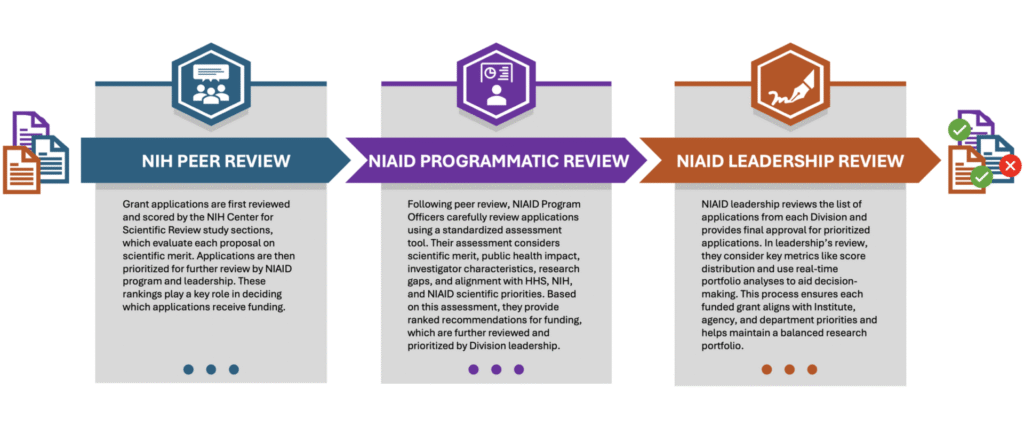
The key part of this is how the last two steps repeatedly emphasize aligning with HHS priorities. Now, it’s always been true to some extent that NIH-funded research has to align with NIH priorities. However, that’s not quite what we’re talking about here. What we’re actually talking about is putting the final funding decisions into the hands of political appointees, rather than the usual career scientists who have traditionally sat on the advisory councils that look at scored grants to come to a decision regarding which grants will be funded within the budget available:
And if you don’t believe me, check out this story in Nature from last month:
Crucial grant-review panels for more than half of the institutes that make up the US National Institutes of Health (NIH) are on track to lose all their voting members within the year. Federal law requires these panels to review applications for all but the smallest grants before funding can be awarded, meaning that the ability of those institutes to issue new grants could soon be frozen.
All of the NIH’s 21 institutes and three of its six centres have their own panel, called an advisory council. Membership on the councils has been dwindling as members serve out their terms without replacements being appointed. At 12 of the institutes and one of the centres, the last voting member’s term is set to expire by the end of this year, according to rosters on federal websites (see ‘Shrinking pool of advisers’). It typically takes several years for a new member to be onboarded.
Dozens of scientists who were poised to fill these vacancies were dismissed last year by the administration of US President Donald Trump, Nature reported in July.
That’s right. The Trump administration appears to be clearing the deck in order to replace advisory council members with political appointees who will have final say over which grants are funded. Still don’t believe me? After all, some of these panels, if they have no members, will simply be unable to fund any grants, thus freezing grant issuing in scientific subjects the administration doesn’t like. Maybe, but take a look at this:
The statute allows the HHS secretary, Robert F. Kennedy Jr, to circumvent the vetting process and handpick panellists. This practice is very rare but not unprecedented, Lauer says. The HHS spokesperson did not respond to Nature’s queries about whether Kennedy plans to do this.
RFK Jr. will do it. Mark my words. I predict that by the end of 2026 this process for appointing advisory council members will no longer be rare. It will be the norm. RFK Jr. will pick whomever he wants as panelists, and they will dole out grants as patronage, rewarding MAHA supporters and MAHA-aligned projects, all while eliminating funding for science projects that conflict with the administration’s ideology.
The NIH has been an engine of scientific and economic development for 76 years. It is the crown jewel of US science and a shining example of what government can do when it actually does act for the public good. Longtime readers might remember a post from three years ago, when I discussed a conspiracy theory in which antivaxxers and COVID-19 cranks portrayed NIH grant funding decisions as if Anthony Fauci personally doles out NIH dollars like a mob boss to scientists who support him and withholds grant dollars from those who do not or those who do research that he doesn’t approve of. That makes it especially ironic how, under the “leadership” of the useful idiot Podcast Jay, the Trump administration is clearly moving to turn the system by which the NIH funds grants into one in which Trump’s minions dole out research funds based on loyalty, rather than the strength of their science.
Lysenko couldn’t have done it better himself, and the damage to US science will take a generation to recover from; that is, if we can ever recover from it.